




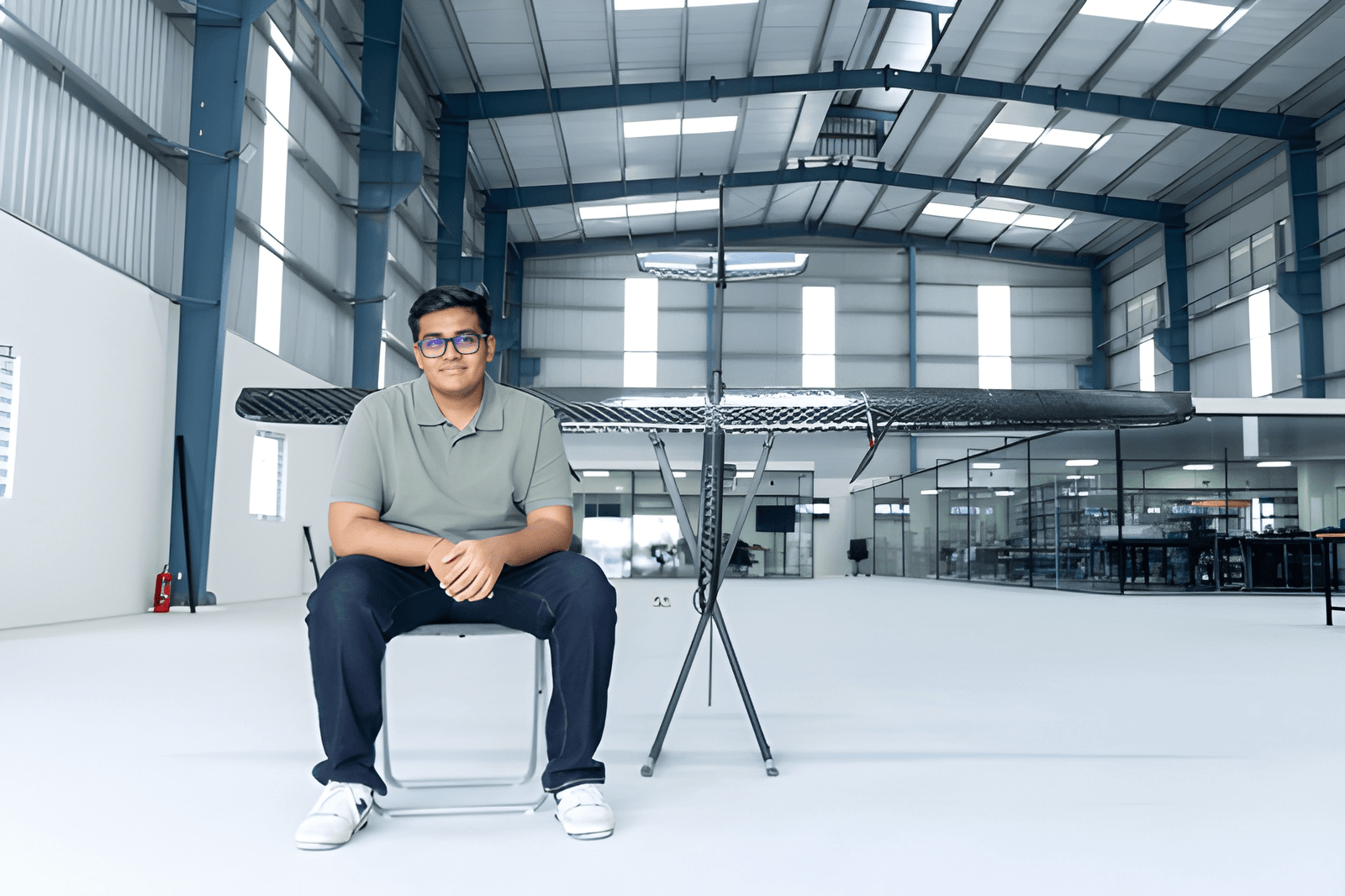
Alteon, founded by 20-year-old Samay Sanghvi, has raised $2.5 million in a pre-seed funding round led by Groom, with participation from Together Fund. The startup will use the capital to develop autonomous aircraft inspired by dynamic soaring, a technique that albatrosses use to extract energy from the wind.
According to Sanghvi, Groom decided to invest in Alteon within the first 30 minutes of their initial meeting. The startup aims to challenge the limitations of conventional aircraft, which must carry sufficient fuel or battery power to complete their flights.
Alteon is developing small, fixed-wing autonomous aircraft designed to extract energy from wind shear above the ocean through dynamic soaring. The technique involves repeatedly moving between layers of air travelling at different speeds to gain energy from the wind.
“Once you build airplanes that can stay in the air for more than a year, there are millions of things you can do with them,” Sanghvi said.
Initially, Alteon plans to deploy its aircraft for maritime surveillance, enabling governments to gain real-time visibility into activities within their waters.
The startup’s first aircraft will have a wingspan of around three metres. It will fly close to the ocean’s surface, climb into faster-moving air, turn, and repeat the cycle to extract energy from the wind. Eventually, Alteon also plans to use its propellers as turbines to convert wind energy into electricity and recharge its onboard batteries.
However, Alteon has not yet demonstrated that its aircraft can sustain flight entirely through energy harvested using dynamic soaring. Nevertheless, the startup recently tested its autonomous flight system over the Bay of Bengal, where the aircraft autonomously completed seven O-shaped cycles at speeds exceeding 62 miles per hour while flying within one metre of the water’s surface.
Alteon’s next major milestone involves achieving what Sanghvi calls “energy-neutral dynamic soaring.” This capability would allow the aircraft to remain airborne continuously with its propulsion switched off while extracting sufficient energy from the wind.
Dr. Gabriel Bousquet, a Silicon Valley-based aerospace and robotics engineer who researched dynamic soaring during his PhD at MIT, described Alteon’s low-altitude flight over water as a “promising first result.” However, he noted that the startup must still prove that its aircraft can reliably extract enough energy from real-world winds to sustain extended flights.
Bousquet also highlighted the challenges of flying close enough to the ocean’s surface to harvest wind energy safely. The aircraft must navigate turbulence, waves, spray, rain, and changing light conditions while continuously sensing and responding to the moving ocean surface.
Dr. Bharath Swaminathan, who earned his PhD from IIT Madras studying the stability of dynamic soaring, said the underlying physics behind the technology is well established and described Alteon’s efforts as commendable.
Swaminathan added that keeping an aircraft airborne for several days using dynamic soaring would represent “a very big step and a big achievement.” However, he noted that local wind shear and turbulence can vary significantly, even when large-scale wind conditions remain predictable. Therefore, real-world flight testing may reveal additional challenges.
Groom acknowledged the technical risks involved in Alteon’s ambitious mission. “Ambitious problems are always going to come with risks,” he said. “For me, it came down to believing Samay and the Alteon team are the ones to figure them out.”
Sanghvi started working on the concept behind Alteon immediately after high school in 2023. He learned aircraft development by building and crashing radio-controlled models before developing early prototypes. He formally founded Alteon in 2025 and secured early backing from Emergent Ventures and 1517.
Today, Alteon employs a team of 20 people in Bengaluru and operates from a 10,000-square-foot facility. The startup currently builds four to five aircraft every week for testing and has conducted more than 200 test flights over the past 30 days.