




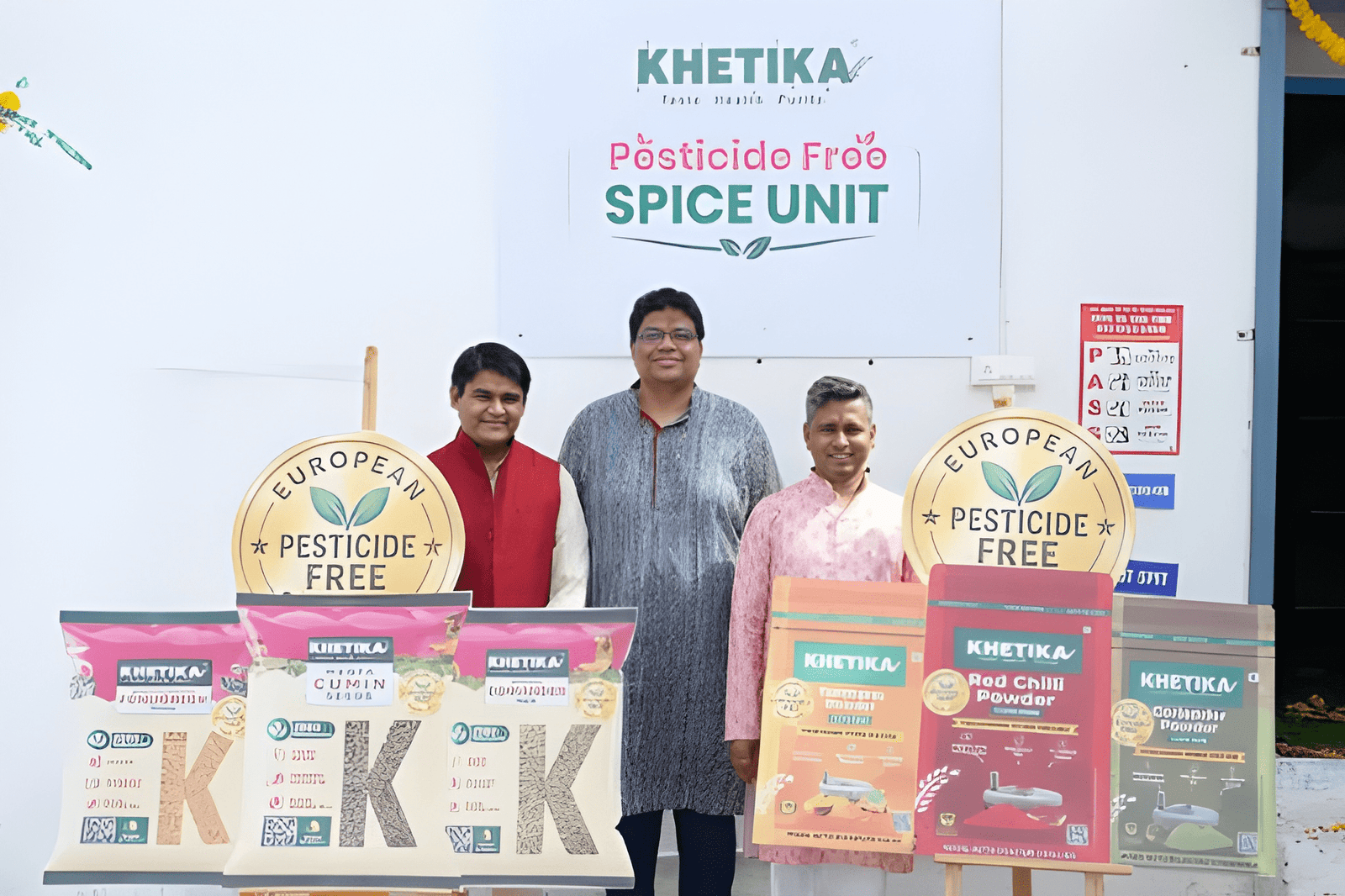
Homegrown clean-food brand Khetika is significantly increasing its focus on spices, targeting Rs 1,000 crore in annual revenue from the category within three years. The company aims to make spices its largest growth engine and build a Rs 2,000 crore spices business over the next five years.
As part of the expansion, Khetika has invested Rs 10 crore in a 15,000 sq ft pesticide-free spices manufacturing facility and advanced quality laboratory in Unjha, Gujarat. The facility has an initial capacity of 500 MT. The company plans to increase its investments in the facility and related infrastructure to Rs 100 crore over the next three years as demand expands.
“Spices would be the largest division in the future. The market is huge, and unlike our batter business, which is restricted to cities where we have manufacturing plants, spices can be scaled across the country and globally,” said Dr. Prithwi Singh, co-founder and CEO, Khetika.
Khetika currently operates seven manufacturing units, including four fresh-product facilities located in Bengaluru, Hyderabad, Delhi, and Mumbai. Its product portfolio includes batters, healthy snacks, dry fruits, makhanas, and spices, with the three major categories currently contributing roughly equally to revenue.
The company expects this revenue mix to change considerably over the next few years, with spices projected to account for 50 percent of overall revenue in the next 3-4 years.
“We are targeting around Rs 1,000 crore in annual spices revenue within three years, and our larger ambition is to build a Rs 2,000 crore spices business over five years,” Singh said.
Overall, Khetika expects to close the current fiscal at around Rs 500 crore revenue, compared with Rs 375 crore in FY26. Online channels are expected to contribute Rs 120-150 crore during the year.
The new Gujarat facility is designed to address quality and safety requirements for global markets. Its dedicated pesticide-free manufacturing unit currently has a capacity of 500 MT, while the advanced laboratory will conduct pesticide residue, microbiological and chemical testing, nutritional analysis, shelf-life studies, and other quality assessments.
“India is the world’s largest spice exporter, yet we are yet to see an Indian consumer spice brand emerge as a global leader. Our new facility and testing laboratory are important steps towards that ambition,” he said.
Khetika is also expanding its farmer ecosystem through the Khetika SAATHI programme. The initiative currently covers around 20,000 farmers, with the company targeting an expansion to 50,000 farmers.
“When we reach Rs 1,000 crore, we expect 20 per cent of our revenue to come from international markets,” Singh said.
The company’s increased focus on spices reflects a broader opportunity for Indian consumer brands to build scalable food businesses around categories with both domestic and international demand. Unlike fresh products and batters, which require manufacturing facilities closer to consumers, spices can be distributed across wider geographies, potentially enabling Khetika to expand nationally and internationally without the same location constraints.
Khetika also expects to achieve EBITDA profitability in Q4 of the current fiscal year while continuing to invest in capacity, brand building, and distribution.
The company plans to use its expanded manufacturing infrastructure, quality capabilities, and farmer network to accelerate its spices business. With targets of Rs 1,000 crore in annual spices revenue within three years and a Rs 2,000 crore spices business over five years, Khetika is positioning the category as the central pillar of its next phase of growth and international expansion.