




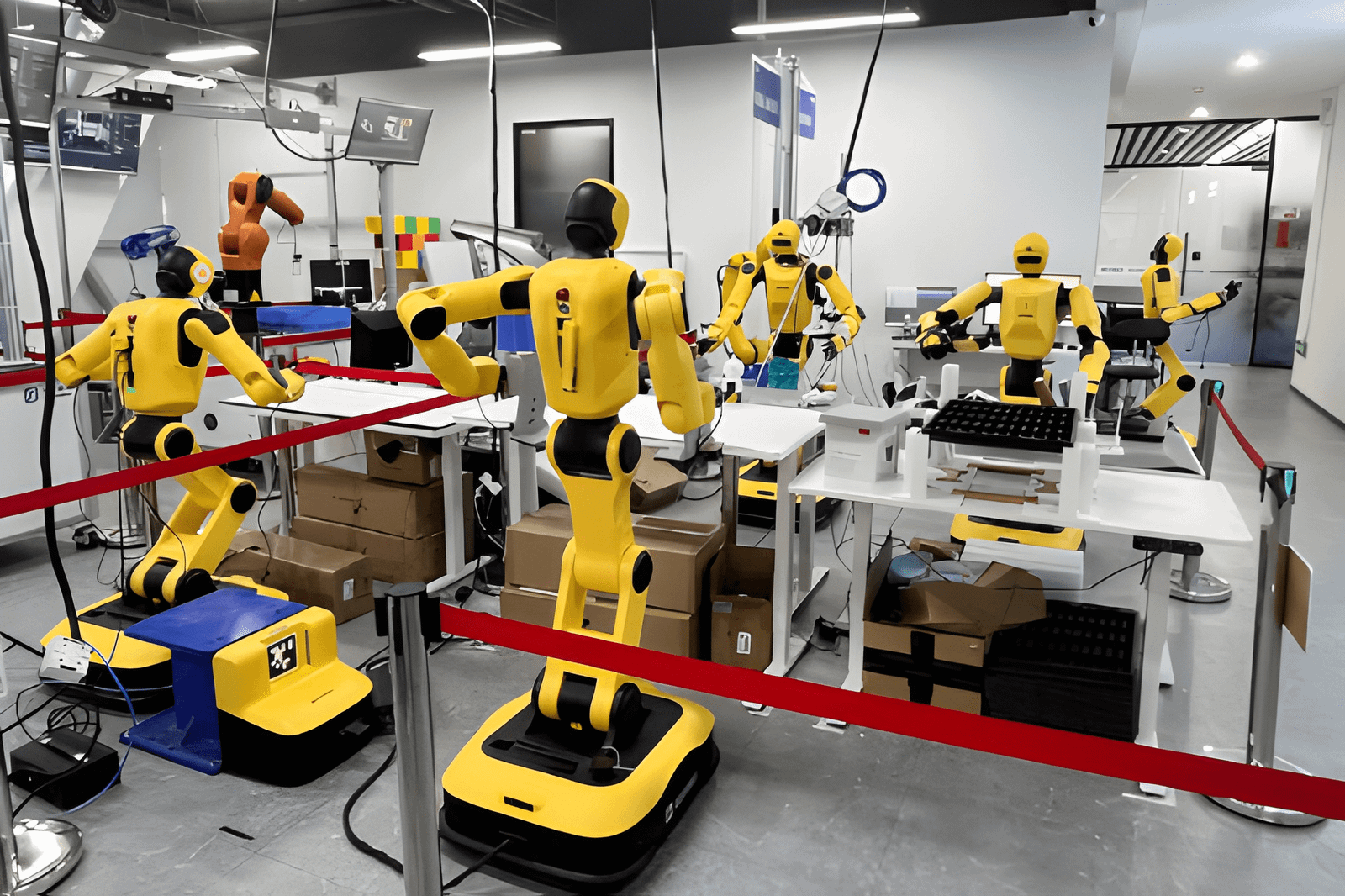
Chinese robotics startup DexForce is using AI-powered simulations and synthetic data to address one of the humanoid robotics industry’s biggest challenges: training machines to perform a wide range of real-world tasks autonomously.
At the company’s offices in Shenzhen, a virtual robot repeatedly practises placing objects on a table while the arm angles, table colours and objects change. Through these simulated environments, DexForce aims to improve robot training efficiency while reducing the cost of collecting real-world data.
Although China has developed humanoid robots capable of outperforming humans in running and jumping, enabling them to perform useful tasks reliably in factories, offices, and homes remains a significant commercial challenge.
Many Chinese robotics companies are addressing this problem by collecting extensive datasets from human workers performing repetitive tasks in real-world environments. However, DexForce is taking a different approach by generating synthetic data in virtual environments to accelerate training and reduce costs.
Chief Executive Jia Kui told that this approach could accelerate advances in robotic capabilities, potentially triggering a breakthrough comparable to the impact of ChatGPT’s 2022 launch on generative AI adoption.
“Trying to achieve ‘physical artificial general intelligence’ purely through real-world data collection would require 10 trillion samples … manual (data) collection for infinite human tasks is fundamentally inefficient,” said Jia. He was referring to a technological milestone in which humanoid robots can execute unfamiliar tasks on command in environments they have never encountered before.
Achieving this capability requires AI systems that can perceive their surroundings, navigate physical environments, and adapt to changing conditions. To address these requirements, DexForce develops AI software that simulates physical environments and models that predict how objects move and interact.
The company creates digital replicas of workplaces and tasks, trains robots within these virtual settings, and subsequently transfers the acquired knowledge to physical machines. According to DexForce, this method is faster and more cost-effective than collecting data from human trainers, who may need to repeat a movement more than 100 times to produce precise training examples.
Meanwhile, China is investing heavily in humanoid robot training infrastructure, with dozens of data collection centres under development nationwide. These facilities involve substantial expenditure and often depend on government subsidies. Nevertheless, access to high-quality training data remains a major bottleneck for the industry, even as most Chinese robotics companies combine simulated training with real-world data collection.
Jia, a machine-learning professor at the Chinese University of Hong Kong, Shenzhen, founded DexForce in 2021. The startup employs approximately 500 people and counts Lenovo Capital, the investment arm of Lenovo, and Lens Technology among its backers, alongside several state-owned funds.
Recently, DexForce raised 1 billion yuan ($147 million) in a Series B funding round at a valuation exceeding 10 billion yuan. The investment will support the company’s continued development in robotics simulation and AI-driven training technology.
As humanoid robotics companies compete to develop machines capable of performing practical tasks independently, DexForce is betting that synthetic data and advanced simulation technology can help overcome training limitations and accelerate the commercial deployment of physical AI.