




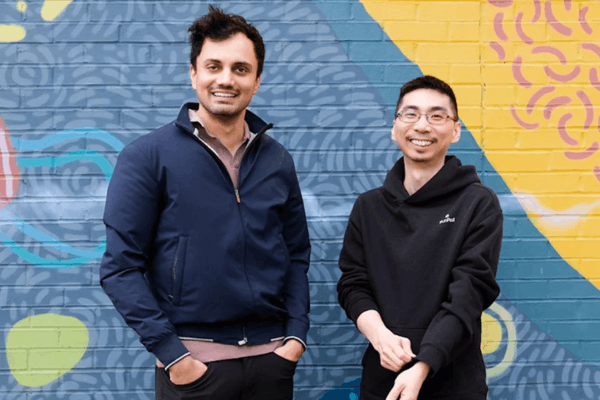
Runpod, an AI application hosting platform launched four years ago, has reached a $120 million annual revenue run rate, according to founders Zhen Lu and Pardeep Singh.
Overall, their startup journey demonstrates how strong execution combined with favorable timing can drive outsized outcomes.
Notably, the story spans several inflection points: bootstrapping to more than $1 million in revenue; securing a $20 million seed round after VC Radhika Malik, a partner at Dell Technologies Capital, discovered the company through Reddit posts; and attracting a key angel investor, Hugging Face co-founder Julien Chaumond, who reached out after using the product and contacting support. Importantly, the journey began in late 2021 when the two friends, then corporate developers at Comcast, decided their side hobby no longer excited them.
Initially, they had built specialized computer setups in their New Jersey basements to mine Ethereum. Although they generated some cryptocurrency, the returns failed to justify the investment. Moreover, mining faced an impending end following the much-publicized network upgrade known as “The Merge.”
Beyond that, the activity quickly became monotonous. “On top of that, it was ‘boring’ after a couple of months,” Lu said.
However, Lu and Singh had already convinced their spouses to let them spend nearly $50,000 on the hobby between them. Consequently, they knew that maintaining domestic peace required finding a productive use for those GPUs.
At the same time, both developers were working on machine learning projects professionally, so they decided to repurpose their mining rigs into AI servers. This shift occurred well before ChatGPT and even before DALL-E 2. As they rebuilt the systems, they uncovered a major issue. “We were seeing how really god-awful the software stack was for dealing with these GPUs,” Lu said. From a developer’s perspective, they had found a problem worth solving.
As a result, Runpod emerged. The company was born, as Lu put it, “because we felt that the actual experience of developing software on top of GPUs was just hot garbage.”
A few months later, in early 2022, the founders felt ready to share their product. Runpod positions itself as a platform for hosting AI applications, with a strong emphasis on speed, easily configurable hardware—including a serverless option that automates setup—and developer tools such as APIs, command-line interfaces, and integrations.
At that stage, the platform supported only a handful of integrations, including Jupyter notebooks. Next, the founders faced a new challenge: finding beta users. “As first-time founders, we didn’t really know how to market or how to do anything,” Lu recalled. “So I’m like, all right, let’s just post on Reddit.”
Accordingly, they posted in several AI-focused subreddits, offering free access to their AI servers in exchange for feedback. That strategy succeeded. They attracted beta users, converted them into paying customers, and within nine months quit their jobs after reaching $1 million in revenue.
Nevertheless, success created new pressure. “Six months in, business users were like, ‘Hey, I want to actually run real business stuff on your platform. But I cannot run it on servers that are in people’s basements,’” Lu said.
Up to that point, the founders had not considered raising venture capital. Instead, they formed revenue-sharing partnerships with data centers to expand capacity. Still, the approach proved stressful. The team had to stay well ahead of demand. “If we don’t have the GPUs, the market sentiment, the user sentiment changes. Because when they don’t see capacity from you, they go somewhere else,” Singh explained.
Meanwhile, the community around Runpod grew rapidly on Reddit and Discord, especially after the launch of ChatGPT. At the same time, investors began actively scouting for AI infrastructure opportunities.
Eventually, Malik noticed Runpod on Reddit and initiated contact, marking the company’s first VC conversation. At that moment, Lu lacked experience pitching investors. “Radhika was super helpful, even at the first conversation,” he said. She explained how venture capitalists think and committed to staying in touch.
Despite that interest, Lu remained focused on operating a self-sustaining business. “It was almost two years where we really didn’t have any funding,” he said. Consequently, Runpod never introduced a free tier. The platform had to cover its own costs, even if profits remained modest. Unlike other AI cloud services that originated from crypto mining, the founders deliberately avoided taking on debt.
By May 2024, as enthusiasm for AI applications surged, their early decision to build an AI hosting platform for developers began to pay off. The company had grown to 100,000 developers and closed a $20 million seed round co-led by the venture arms of Dell and Intel, with participation from prominent investors such as Nat Friedman and Chaumond.
Since then, the company has not raised additional capital. However, the founders now plan to pursue a new round, confident that their traction supports a strong Series A.
Today, Runpod serves approximately 500,000 developers, ranging from individual users to Fortune 500 enterprise teams spending millions annually, according to the founders.
Furthermore, the company operates cloud infrastructure across 31 global regions and counts customers such as Replit, Cursor, OpenAI, Perplexity, Wix, and Zillow among its users.
Even so, competition remains intense. Developers can choose from hyperscalers like AWS, Microsoft, and Google, as well as specialized providers such as CoreWeave and Core Scientific.
Nevertheless, Lu and Singh view Runpod differently—as a developer-first platform built for the future. They believe coding will not disappear but will evolve, with programmers increasingly acting as creators and operators of AI agents.
Ultimately, Lu summarized their ambition clearly: “Our goal is to be what this next generation of software developers grows up on.”