

Terraspark, a Luxembourg-based startup focused on developing space-based solar power, has successfully completed its pre-seed funding round, raising over €5 million. The company will use the capital to further advance its modular technology while also preparing for initial pilot applications and live demonstrations.
The funding round attracted backing from notable investors, including Daphni, Sake Bosch, Better Ventures, Hans(wo)men Group, Luxembourg Business Angel Network, and Karaoke Club.
“Space-based solar power has long been considered something for the distant future. Across Europe, energy resilience is now a practical concern, not an abstract one. With our step-by-step approach and starting with commercially viable systems on Earth, we are convinced that space-based solar power can become real infrastructure within a realistic timeframe,” said Jasper Deprez, founder and CEO of TerraSpark.
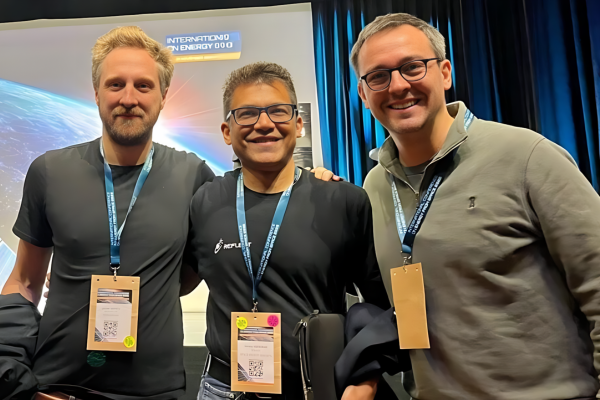
Deprez, Dr. Sanjay Vijendran (CTO), and Matthias Laug (COO) founded Terraspark in 2025, and the company is building space-based solar power (SBSP) systems with a long-term vision to transmit solar energy from orbit. The company aims to create a continuously operational, weather-independent, and globally accessible energy infrastructure.
The founding team brings deep domain and entrepreneurial expertise. Deprez previously built Tradler into a global HRTech platform. Meanwhile, Dr. Vijendran led the Solaris programme on space-based solar energy at the European Space Agency and also contributed to the Mars Sample Return Mission. In addition, Laug co-founded Lieferando and Tier Mobility, gaining extensive experience in scaling large European platform businesses.
Fragile grids, rising electricity demand, and overloaded transmission systems continue to make reliable energy distribution increasingly complex. Furthermore, the rapid expansion of data centres driven by AI adoption is placing additional pressure on energy systems.
Terraspark also points out that the International Energy Agency expects global data centre energy demand to more than double by 2030. In off-grid environments, where diesel generators remain common, electricity costs can range between €0.70 and €1.50 per kilowatt hour. Even in regions with abundant clean energy, inefficient transmission infrastructure often prevents effective distribution. Therefore, long-term solutions must address both sustainable generation and global energy transmission.
To solve this, Terraspark is developing space-based solar energy systems that capture solar power in orbit. The company then transmits this energy to Earth using radio frequency waves, enabling global accessibility. Although the concept has existed since the 1970s, falling launch costs and advances in satellite manufacturing and orbital robotics now make it economically viable.
However, instead of immediately deploying large-scale orbital systems, Terraspark is initially focusing on Earth-based applications. Specifically, it is commercialising radio frequency-based wireless energy transmission for industrial use cases. This phased approach allows the company to demonstrate safety, efficiency, and regulatory compliance before scaling to orbital systems.
Explaining its operational model, Terraspark captures solar energy in space and transmits it to Earth via a steerable radio frequency beam. A ground-based rectenna converts these radio waves into usable electricity, while the system uses batteries only to manage short, predictable interruptions.
“In the coming months, TerraSpark will prepare its first pilot applications and demonstration use cases—including wireless power supply for a live event. An orbital technology demonstrator is also planned for 2027. At the same time, the company is laying the groundwork for its first space-to-Earth power transmission, planned for 2028,” the company stated in its press release.
Looking ahead, Terraspark has outlined a three-phase roadmap. In Phase 1 (2026), it will wirelessly transmit power over controlled distances on Earth to validate alignment accuracy, energy density, and atmospheric tolerance. Subsequently, Phase 2 (2027–2028) will involve demonstrating power beaming from orbit using an SBSP satellite prototype. Finally, in Phase 3 (2030), the company aims to achieve full-scale commercial deployment by launching a constellation of satellites capable of delivering continuous, reliable energy worldwide.
While its phased, modular strategy reduces execution risk, its success will depend on technological validation and regulatory alignment. If achieved, space-based solar power could redefine global energy distribution by offering a continuous, weather-independent, and scalable solution to rising energy demand.