




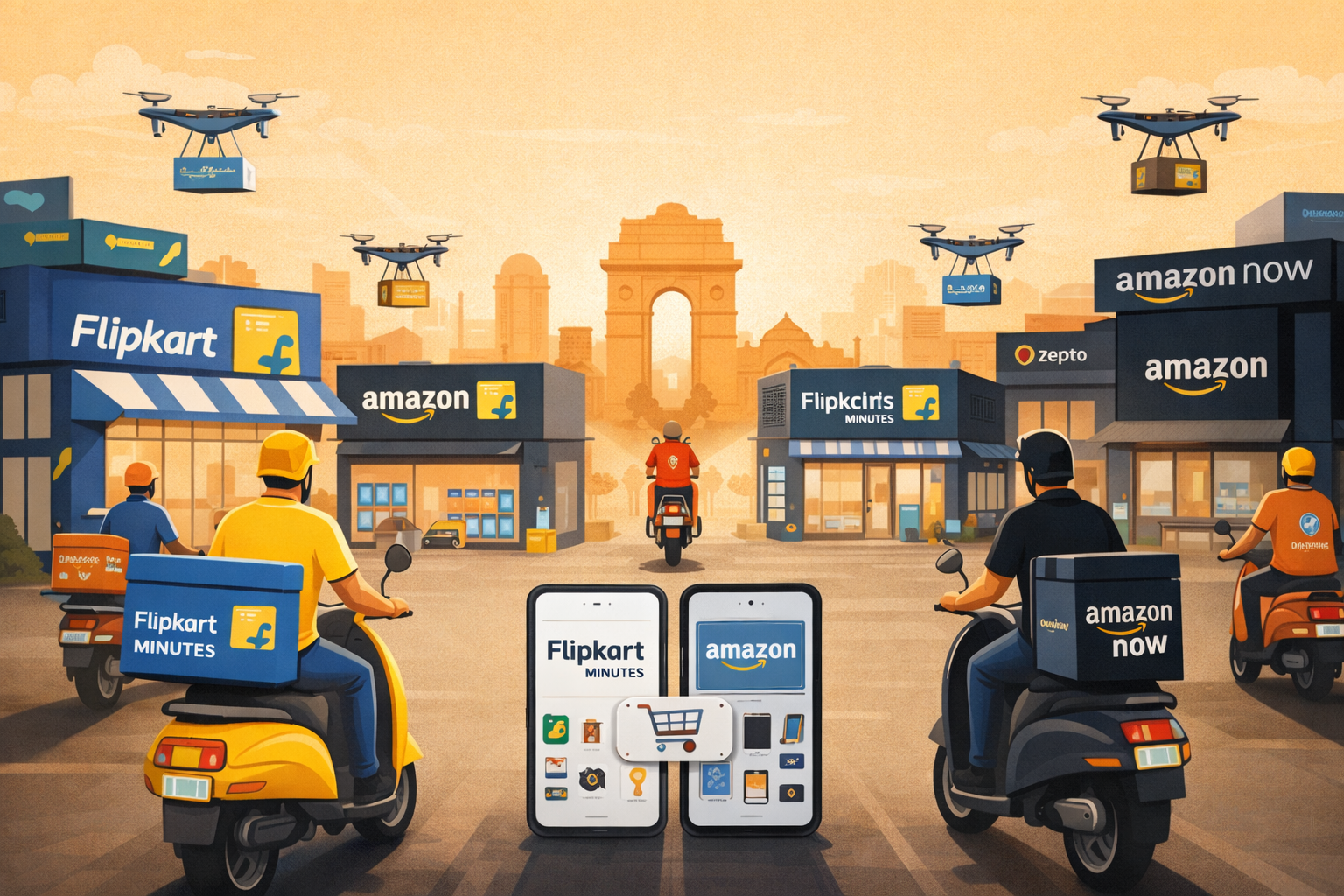
Flipkart and Amazon are rapidly expanding their dark stores across India, while early quick commerce pioneers are slowing their growth to focus on profitability. At the same time, industry discussions around last-mile employment conditions continue to intensify, which adds another layer of complexity to the sector’s rapid expansion.
Flipkart, the Walmart-owned e-commerce giant, launched its quick commerce service, Minutes, in August 2024. Since then, the company has aggressively scaled its infrastructure to capture a larger share of India’s fast-growing instant delivery market.
Sources indicate the company has been adding roughly 100 dark stores per month this year, and it plans to reach around 1,200 stores by June, up from 750–800 currently. Meanwhile, Minutes already operates in 70–75 cities; however, the company aims to expand its presence to 220–250 cities by June, which highlights its aggressive growth strategy.
At the same time, Amazon has also accelerated the rollout of its Amazon Now quick commerce service since December. Consequently, Amazon Now is expected to reach approximately 500 dark stores in the near future as the company strengthens its last-mile delivery capabilities in India.
Meanwhile, Reliance JioMart is pursuing a different strategy to compete in the quick commerce market. Instead of building new dark stores, the company is leveraging its existing retail network to fulfill orders more efficiently. As a result, the company currently handles nearly 1.6 million orders daily, which brings it close to Blinkit’s 2 million daily orders and places it ahead of Swiggy Instamart and Zepto in daily order volume.
By utilizing its established supply chain strength—particularly in fruits and vegetables—Reliance claims contribution-margin positivity. In other words, the company earns money on each order after accounting for direct operational costs.
Meanwhile, other quick commerce players are actively seeking significant funding to sustain competition and growth. Swiggy and Zepto, for instance, are pursuing ₹215,000 crore from public markets as they prepare to scale operations while improving financial sustainability.
At the same time, quick commerce platforms are expanding beyond grocery deliveries to capture higher-margin product categories. Flipkart Minutes, for example, has started delivering mobiles and electronics within 15–20 minutes, which signals a major shift in the sector’s product mix.
Moreover, non-grocery items now contribute nearly 20% of average sales across quick commerce platforms. Because these products often carry higher margins, they offer companies a stronger path toward profitability.
Therefore, analysts believe that expanding into electronics and other high-value products could significantly improve margins while enabling platforms to scale their operations more efficiently in India’s competitive quick commerce landscape.
Flipkart and Amazon are aggressively scaling their dark-store infrastructure to dominate India’s rapidly evolving quick commerce market. Meanwhile, competitors are focusing on profitability, funding, and diversified product offerings. As companies expand into high-margin categories like electronics and strengthen supply chains, the sector will likely witness even fiercer competition and faster innovation in the coming years.