




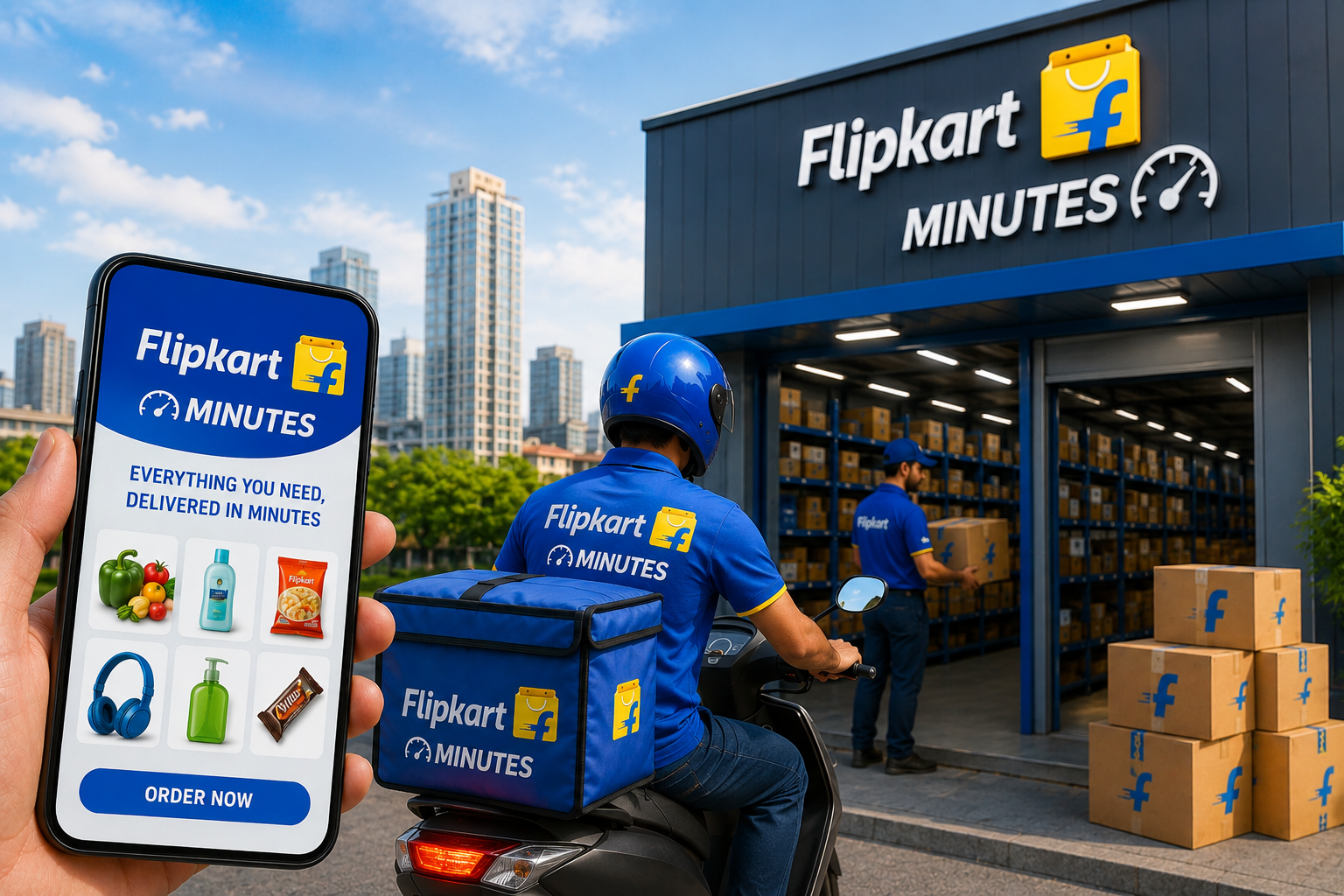
India’s quick commerce industry continues to witness unprecedented growth, and Flipkart Minutes has now achieved a major milestone in the rapidly evolving sector. Walmart-backed Flipkart announced on Wednesday that its quick delivery platform, Flipkart Minutes, has established a network of 1,000 micro-fulfillment centers across the country in less than two years since its launch. These strategically located warehouses enable ultra-fast deliveries and strengthen Flipkart’s position in India’s increasingly competitive quick commerce market.
Furthermore, the company plans to expand its network to 1,500 micro-fulfillment centers by the end of 2026. This aggressive expansion strategy will help Flipkart increase its market presence as competition intensifies among major players such as Blinkit, Zepto, Swiggy Instamart, and Amazon.
According to a recent Jefferies report, Flipkart could become India’s second-largest quick commerce network by micro-fulfillment center count based on existing store numbers and announced expansion plans. Currently, Blinkit leads the segment with 2,243 micro-fulfillment centers, while Zepto and Swiggy Instamart continue to scale their infrastructure to capture a larger share of the market.
India has emerged as one of the world’s fastest-growing quick commerce markets. Companies across the sector continue to invest heavily in infrastructure, technology, and customer acquisition to deliver groceries, electronics, beauty products, personal care items, and household essentials within minutes. Blinkit, owned by Eternal, currently dominates the segment, while Zepto, Swiggy Instamart, Flipkart, and Amazon continue to strengthen their footprints nationwide.
Meanwhile, Amazon has accelerated the rollout of Amazon Now in recent months. The service currently operates in more than 15 cities and utilizes over 500 micro-fulfillment centers. Amazon aims to expand the service to 100 cities while operating more than 1,000 micro-fulfillment centers. Additionally, the company plans to diversify its product assortment beyond groceries and offer categories such as fashion, consumer electronics, and home products.
Consumer shopping behavior on Flipkart Minutes has also evolved significantly since the platform launched in August 2024. Demand now extends beyond grocery purchases and increasingly includes electronics, beauty products, and personal care items. Kunal Gupta, Head of Flipkart Minutes, shared these insights during an interview.
According to Gupta, orders on Flipkart Minutes have increased by approximately 400% compared to the previous year, while customer retention has improved by 20% year-over-year. However, the company provided both figures, and independent verification remains unavailable.
“What began as a way to fulfill everyday essentials has evolved into a fundamentally new shopping habit for millions of Indians,” Gupta said. “Customers are not just ordering more; they are ordering differently.”
In addition, Flipkart has expanded Minutes operations to more than 130 cities and over 8,000 postal codes across India. The company has increasingly driven growth from smaller cities beyond major metropolitan regions. According to Flipkart, these emerging markets delivered growth exceeding 4,000% compared to the previous year, supported by expansion into 90 new cities.
Gupta emphasized that newly launched markets continue to mature at a faster pace than expected. He highlighted cities such as Patna, Guwahati, and Siliguri as examples where newly opened fulfillment centers have gained traction rapidly. He also identified Lucknow as one of the platform’s strongest-performing markets despite the company not yet achieving complete network coverage across the city.
Similarly, Amazon continues to focus on smaller cities and emerging markets. The company informed TechCrunch that 70% of its new Prime members originate from non-metro locations. Amazon also stated that it remains on track to double its Prime membership base from 2023 levels by the end of the year. Additionally, the company revealed that everyday essentials now account for one out of every two units shipped through Amazon.in, while Amazon Now has encouraged customers to shop more frequently.
Gupta further noted that customers increasingly use Flipkart Minutes alongside the company’s core e-commerce platform rather than replacing traditional online shopping entirely. This complementary usage pattern has increased purchasing frequency and supported category expansion into fresh produce and daily essentials. The company also reported a 30% year-over-year increase in average order values for fruits and vegetables.
Looking ahead, Flipkart plans to maintain its aggressive growth trajectory by opening between 75 and 100 micro-fulfillment centers every month. Simultaneously, the company intends to expand its operations into additional cities throughout India.
The rapid expansion efforts by both Flipkart and Amazon highlight India’s growing importance as a global testing ground for the future of e-commerce and quick commerce. Companies increasingly seek to transform quick commerce from a grocery-focused delivery model into a comprehensive shopping ecosystem that caters to a wide range of consumer needs.
Industry data from Bernstein indicates that India already hosts more than 5,500 dark stores. Analysts expect this number to increase to approximately 7,500 by 2030 as companies expand deeper into Tier-II and Tier-III cities while broadening their product portfolios.
“We will continue to expand rapidly, will not slow down after 1,000 stores as well, and we are going all in,” Gupta said.
As India’s quick commerce market continues to expand at an unprecedented pace, Flipkart Minutes and Amazon remain at the forefront of a transformation that is reshaping consumer shopping habits. With aggressive investments in dark stores, micro-fulfillment centers, logistics infrastructure, and category expansion, the sector is moving far beyond grocery delivery. Consequently, the next phase of India’s e-commerce growth will likely depend on how effectively companies scale operations, improve delivery speeds, and capture demand from emerging cities across the country.