




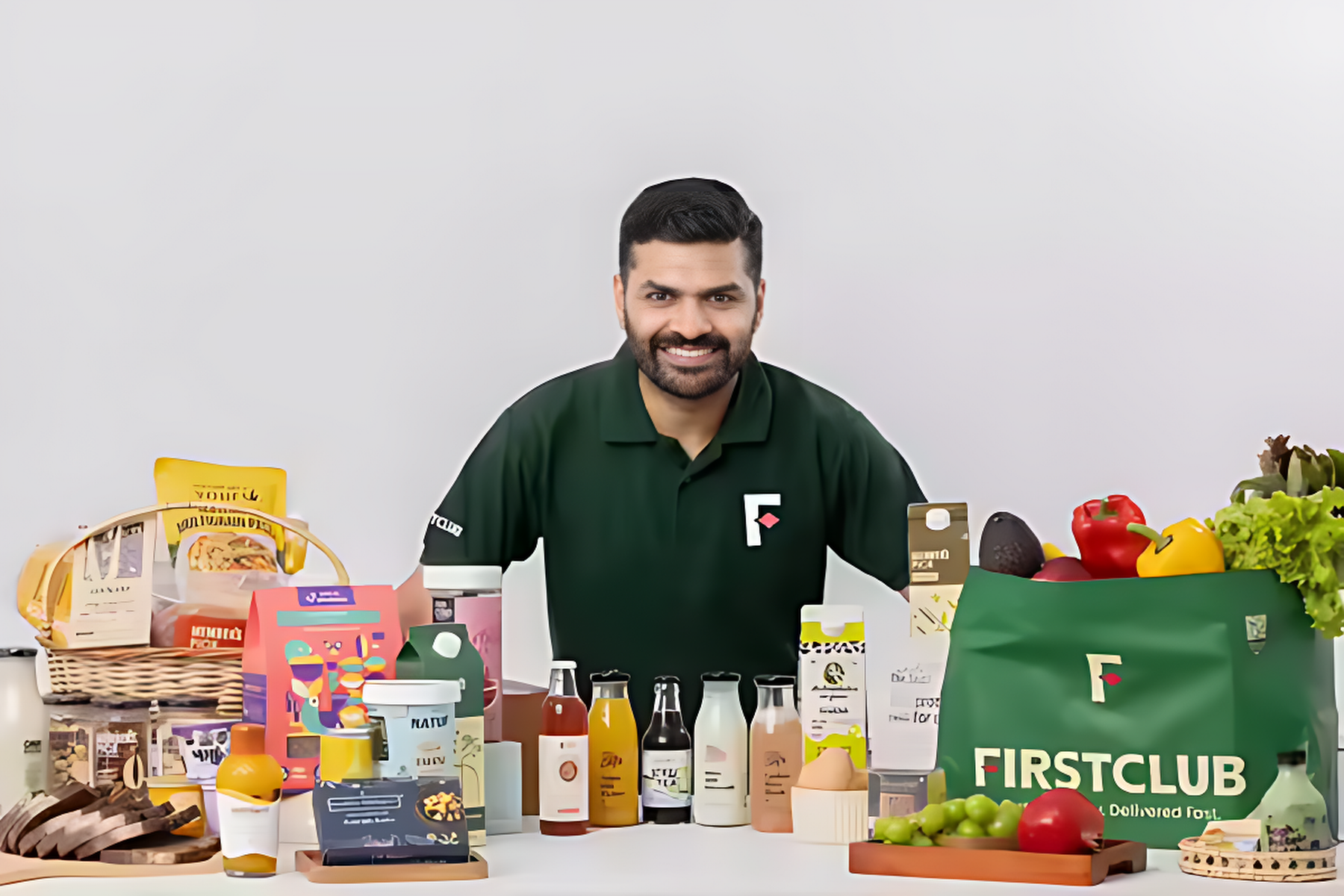
Former Flipkart executive Ayyappan R-founded grocery delivery startup FirstClub has secured $55 million in a Series B funding round led by Peak XV Partners and Sofina. The investment has more than doubled the startup’s valuation within just one year of its launch, highlighting growing investor confidence in the company’s quality-focused business model.
The funding round values FirstClub at approximately $255 million, founder and chief executive Ayyappan R said. Additionally, existing investors Accel, RTP Global, and Paramark Ventures participated in the round, reinforcing their commitment to the rapidly growing grocery delivery platform.
FirstClub will deploy the newly raised capital to expand into additional cities, strengthen its supply chain infrastructure, enhance its technology capabilities, and diversify into new product categories, including beauty and personal care, home essentials, and pet care.
Unlike many quick-commerce companies that prioritize extensive product assortments, deep discounts, and ultra-fast deliveries, FirstClub has adopted a fundamentally different strategy. Ayyappan emphasized that the company intentionally built its business around quality, trust, and value.
“From day one, we were clear that we were building the antithesis of what retail has typically stood for: massive selection, lowest prices, and fastest delivery. We wanted to build a brand known for trust, quality, and value,” he said.
Currently, FirstClub operates 24 dark stores, which the company refers to as clubhouses. These include 21 locations in Bengaluru and three in Hyderabad. According to Ayyappan, the startup already serves nearly 85% of high-demand pin codes in Bengaluru. Consequently, the company plans to deepen its presence in the city while simultaneously expanding its Hyderabad operations. Moreover, it is evaluating entry into a third city within the next 30 to 60 days.
“We will continue to scale Bengaluru itself. There is still a lot of headroom for us to grow in there,” he said.
Although FirstClub does not publicly disclose its order volumes or gross merchandise value (GMV), Ayyappan revealed that the company has been doubling its order volumes every three months. Furthermore, its gross average order value currently stands at approximately Rs 1,200, which is about 2.5 times higher than the industry average.
“Our higher order value is not because our products are more expensive. It is because customers are ordering 10-11 items in a basket, compared with around four on other platforms,” he said.
Ayyappan also challenged the perception that FirstClub operates as a premium grocery platform. Instead, he stressed that the company’s core focus remains product quality rather than exclusivity.
“It is a misconception that this is a premium play. It is a play on high quality, which need not be accessible only to certain consumers,” he said.
To reinforce its quality-first positioning, FirstClub has prohibited more than 200 ingredients across its platform, including artificial preservatives, artificial colours, growth hormones, and antibiotics. Additionally, the startup conducts laboratory testing and implements stringent quality-control measures such as Brix testing for fruits before listing products on its app.
The company has also deliberately pursued a slower city-expansion strategy compared with many quick-commerce competitors. According to Ayyappan, maintaining strict control over sourcing, product testing, and supply chain quality remains essential to preserving FirstClub’s brand promise.
“To establish a quality-led supply chain takes more time. If we dilute that, there is no difference between us and others,” he said.
At the same time, FirstClub continues to build strong unit economics into its operating model. The company achieves this through a focused product assortment with fewer stock-keeping units (SKUs), higher minimum order thresholds, larger basket sizes, and efficient order batching.
“You should not figure out after five or 10 years how to build a sustainable business. It should be part of how you build from day one,” Ayyappan said.
As India’s quick-commerce and grocery delivery market becomes increasingly competitive, FirstClub continues to differentiate itself through its quality-first strategy, disciplined expansion approach, and sustainable business model. With fresh funding from leading investors and ambitious plans for geographic and category expansion, the startup is positioning itself as a significant player in the evolving Indian retail and grocery ecosystem.
FirstClub’s latest $55 million Series B funding round marks a major milestone in its growth journey. By prioritizing quality, trust, and long-term sustainability over rapid expansion and discount-driven growth, the startup has carved out a unique position in India’s fast-growing grocery delivery market. Backed by strong investor confidence and a clear expansion roadmap, FirstClub appears well-equipped to accelerate its growth while maintaining its commitment to delivering high-quality products and superior customer experiences.