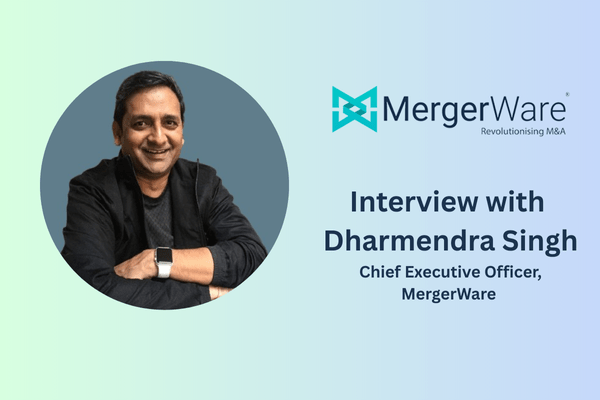
Revolutionizing the mergers and acquisitions (M&A) landscape with cutting-edge technology, MergerWare is setting new benchmarks in the corporate M&A world. In an exclusive interview with Business Review Live, Mr. Dharmendra Singh, the visionary founder of the company, shares invaluable insights into how emerging technologies like Artificial Intelligence are shaping the future of M&A. With a deep understanding of both the industry’s evolving landscape and MergerWare’s pivotal role in streamlining complex transactions, Mr. Singh offers a comprehensive view of his company’s innovative solutions and the impact they are making across the corporate sector. Dive into the world of MergerWare and discover how one man’s forward-thinking approach is transforming the way businesses handle mergers and acquisitions.
1. How has MergerWare’s approach to mergers and acquisitions evolved over recent years with the rise of advanced technologies, particularly AI?
MergerWare is a leading company specializing in mergers and acquisitions (M&A). Our platform centralizes the entire M&A process, ensuring it is easily accessible to all stakeholders. With a controlled model, team members can manage tasks effectively while assigning permissions as needed.
Our platform focuses on tracking and accessibility, and with AI’s rise, we are integrating it into M&A data to boost efficiency. The M&A process has three phases: first, the pre-deal phase, where companies identify potential acquisition targets; then, due diligence, which evaluates if the target meets the buyer’s needs; and finally, the integration phase, where the acquired company merges with the existing organization.
We are using AI in areas like deal screening. For example, when a company needs to narrow down two targets from a thousand, they require extensive data to make an informed decision. Our AI streamlines this by collecting and analyzing data, identifying risks, and assessing the strategic and financial fit of each target. The AI engine gives decision-makers detailed risk profiles and insights, helping them select the best acquisition opportunity.
2. In your opinion, what are the primary challenges the M&A sector faces today, and how does MergerWare’splatform address these through digital transformation and automation?
The M&A process is complex, and cross-border deals add extra challenges. For example, acquiring a European company from the US (or vice versa) involves navigating different regulations across 50 countries, along with aligning teams and operations in various locations.
Many M&A processes still rely on outdated methods, with teams working in silos and using different tools, like Google Drive, Dropbox, or SharePoint. This lack of a unified platform leads to confusion and delays, with employees often focused on their tasks without understanding the bigger picture, leaving key questions unanswered.
Communication issues further complicate the process, as employees, suppliers, and vendors may remain unaware of acquisitions due to poor planning. It’s crucial to inform everyone about changes, but many integration efforts remain disjointed, leaving stakeholders uninformed.
Mergeware addresses these challenges by combining document management, reporting, and dashboards into one platform. CEOs can quickly check updates, eliminating the need for emails or presentations from country managers. With centralized access to key data, authorized users can find information anytime, anywhere, ensuring smoother processes and better organization.
3. AI and machine learning are transforming various business sectors. Can you elaborate on how MergerWare leverages AI to streamline M&A processes and improve decision-making accuracy?
AI is transforming all stages of the M&A process: pre-deal, due diligence, and post-deal integration. In deal sourcing, AI identifies the best acquisition opportunities by helping companies shortlist potential targets and prioritize the most promising ones, making the process faster and more accurate.
During due diligence, AI allows deeper analysis of shortlisted options. Since companies usually acquire only one or two targets, this phase requires careful scrutiny. With sensitive information exchanged between buyers and sellers, AI enhances efficiency and security. For example, in cross-country legal due diligence, AI summarizes multiple reports in seconds, extracting key insights and risks. Instead of manually sifting through documents, users access summaries, comments, and identified risks, making decision-making quicker and more informed.
In the integration phase, AI helps automate repetitive tasks that would otherwise consume significant time. MergerWare pre-configures many tasks, offering suggestions based on best practices, so teams don’t miss crucial activities. This automation frees up time for creating value and building stronger, unified companies.
By streamlining each phase, AI ensures efficiency and maximizes deal potential, making the transition from deal sourcing to integration smoother.
4. Risk management is a critical aspect of any M&A. How does your platform use data analytics and AI to assess and mitigate risks, especially in cross-border transactions?
AI helps identify hidden risks early on. For instance, when planning to acquire a company, I first gather publicly available data without revealing my intention. As I progress, I review financial reports, customer data, and legal contracts, where many risks often emerge.
Legal contracts often include crucial clauses, sometimes just a short line, that hold significant weight. Our AI platform detects these risks early and displays them on a dashboard, keeping you informed for immediate action.
The platform assigns risks to the appropriate team members for resolution. Until resolved, the risk stays visible on the dashboard as a reminder. Each time you log in, you’ll see updates and tasks to address these risks, ensuring effective compliance and policy adherence.
5. Real-time collaboration and transparency are often barriers in M&A. How has MergerWare implemented technology to foster seamless, secure communication and data sharing among stakeholders?
Mergerware offers a pre-built action item checklist and an M&A label on its platform, which is versatile for any type of deal. After customers define their M&A processes, we map them to the platform and grant access to the relevant stakeholders, ensuring the right individuals have the right information. This enables seamless communication, even for legal teams working across multiple countries, allowing them to collaborate, share best practices, and discuss challenges through the built-in chat feature.
Access is restricted to authorized users, keeping deal information secure. Activities are controlled via roles and permissions, so HR teams only collaborate within their department, while legal teams communicate with peers. The deal head has access to all critical information. Limited-access users can perform tasks relevant to their role without unnecessary distractions, ensuring transparency and efficient collaboration while maintaining security.
6. Data security is essential in handling confidential M&A information. Could you share some insights into the security protocols and technologies MergerWare uses to ensure data protection and compliance?
In mergers and acquisitions (M&A), data security is essential. The platform prioritizes security in every process, product, and design. It serves as an information enabler, storing all data securely on the cloud, with storage options based on customer preferences. Data can be hosted on customer-controlled clouds or platforms like AWS, ensuring compliance with local regulations. For instance, servers in Italy or Mexico adhere to their respective security protocols.
The platform restricts access to authorized individuals and offers advanced control over information sharing, allowing users to set permissions on documents, such as view-only or no-editing rights. These controls apply both ways between buyers and sellers, maximizing security. Additional features like watermarks further protect data.
The platform is ISO 27001 certified, ensuring global security compliance. Annual evaluations by an external agency confirm adherence to security protocols, data backup, and deployment methods. Regular surveillance audits maintain certification and compliance with industry standards, such as SOC 1 and SOC 2. These efforts consistently reinforce the company’s commitment to data security and compliance.
7. What role does predictive analytics play in MergerWare’s platform? Can you share examples of how predictive insights have helped clients achieve better outcomes in M&A deals?
Predictive analytics focuses on utilizing customer data effectively. For example, we worked with a Japanese company with extensive data to analyze team performance during integration deals, which involved HR, finance, and legal departments. The goal was to identify the most efficient team by assessing the time taken and the number of activities completed in a set period, like 100 days.
With this data integrated into the platform, advanced analytics provided insights, including predictions about future integration deal success. By analyzing past performance, the platform could predict outcomes and suggest improvements. However, accurate predictions require significant data.
Additionally, we’re developing small predictive models to help customers rank companies in their deal pipeline based on acquisition potential. These models simplify decision-making by identifying the top-performing companies, allowing businesses to leverage data for better strategy and outcomes.
8. Given that the M&A industry is traditionally conservative, how has MergerWare managed to encourage adoption of digital and AI-driven tools among clients who may be less tech-savvy or resistant to change?
Adopting new tools can be difficult for M&A professionals used to Excel. Transitioning them to a new platform like MergerWare requires effort, but the platform offers greater efficiency and collaboration.
MergerWare helps users see its advantages over Excel, such as reducing isolated workflows. While Excel limits collaboration, MergerWare allows multiple users to work together, track progress, and stay guided. It also includes an embedded checklist and template creation features.
This shift tackles a key M&A challenge: value creation. Poor deal execution and lack of integration teams often prevent companies from realizing returns. MergerWare ensures smooth integration, centralized knowledge, and improved communication.
With MergerWare, crucial information stays accessible even if team members leave, unlike Excel-based processes where knowledge is lost. The platform securely stores and shares data, making it an asset to the company.
Organizations are recognizing Excel’s limitations and moving towards more efficient solutions. MergerWare’s user-friendly, Excel-like interface makes the transition easy. Our focus is on helping customers understand and adopt the platform, improving collaboration, streamlining processes, and achieving better M&A outcomes.
9. Given the vast amounts of data processed in M&A, there’s often a risk of ‘data overload’ which can obscure critical insights. How does MergerWare’s platform balance data volume with decision-making clarity, ensuring that AI-driven insights remain actionable without overwhelming stakeholders with excessive information?
Mergers and acquisitions generate large amounts of data from sources like financial records, legal documents, and IT systems. Effectively managing this data is crucial for smooth operations.
Our platform is designed to tackle this challenge by organizing and redistributing data based on roles and permissions. For example, the legal team accesses only legal documents, finance focuses on financial data, and HR sees HR files. Each team has a dedicated folder with only relevant documents, preventing information overload.
The platform also leverages AI to simplify data analysis. AI generates concise summaries, such as highlighting litigation details in a deal, so users can quickly access key information without reviewing multiple documents.
This data redistribution helps teams make faster decisions, with each team focusing on specific, actionable insights. HR may handle 20 documents while finance manages 30, all without sifting through unnecessary data.
Additionally, team leaders can use a dashboard to track progress, view milestones, and plan next steps, avoiding the need to dive into every detail. This approach streamlines data management, ensuring an efficient workflow.
10. M&A success often hinges on post-merger integration, which is notoriously complex. How does MergerWare leverage AI or digital tools to address cultural alignment and human factors in post-merger phases—a critical yet often overlooked component of successful integrations?
Around 80–90% of mergers and acquisitions fail, primarily due to poor integration. Successful integration is crucial to justify the investment in an acquisition. At MergerWare, we focus on two key areas: cultural integration and process alignment.
Acquisitions often bring diverse team members, employees, and customers from various backgrounds. Seamlessly integrating them into the new system is essential. Early involvement of the acquired team in the deal process fosters a sense of belonging and helps them adapt to the new culture and vision.
At MergerWare, integration begins on day one. The acquired team gains immediate access to tools, integration plans, and roadmaps for the first 100 days and beyond. This transparency promotes collaboration and unity, creating a “one team” mindset critical for success.
Our platform simplifies integration by managing information access and encouraging collaboration during the initial 30 days. It also addresses cultural challenges and lays the groundwork for effective communication. Departments like HR and finance follow clear communication plans to convey the acquisition’s purpose, benefits, and future goals, such as launching new products or expanding markets. By prioritizing transparency, collaboration, and clear communication, we help organizations achieve successful mergers and deliver value to stakeholders.
11. AI in M&A is typically associated with financial analysis and risk assessment, but there’s potential in preempting ‘deal fatigue’ and decision paralysis among teams. How does MergerWare’s platform approach the psychological aspects of the M&A process, perhaps by leveraging AI-driven behavioral insights to sustain momentum and engagement?
M&A deals often lead to frustration when people lack the right tools and information. This becomes harder if you’re leading an integration without a dedicated team, relying instead on HR or legal staff who have other priorities. Despite this, the responsibility for completing the work remains yours, making integration nearly impossible without proper support.
The platform addresses this issue by simplifying onboarding. It provides essential information, a clear checklist, and coaching. New users see their key tasks from day one, along with explanations of their importance, allowing them to begin confidently without delays.
Instead of wasting time asking, “What’s next?”, users can log in to view their priorities, update progress, upload documents, and complete tasks. Once done, the system notifies stakeholders, ensuring smooth communication.
Centralized information and automated communication boost productivity by offering clarity and timely assistance. The platform’s AI delivers necessary information when needed, enabling seamless integration and helping teams stay focused on results.
12. The ethical use of AI is becoming more crucial as data plays a central role in M&A. How does MergerWare ensure that its AI-driven tools maintain transparency and ethical standards, especially in sensitive areas like employee data analysis or corporate restructuring insights?
MergerWare’s platform is uniquely designed, including all its AI components, which are developed in-house. This approach eliminates the need for third-party integrations, ensuring greater control and reliability. For instance, our proprietary NLM (Natural Language Model) removes the dependency on external tools like ChatGPT. While integrating with such tools can be beneficial, it also brings risks, such as increased reliance on third parties.
Our primary focus is to keep the platform independent and self-sufficient. However, when necessary, we can integrate with customer-specific tools. For example, if a customer has specific data requirements, we can customize solutions to fit their needs seamlessly.
We intentionally avoid integrating with generic AI applications to prioritize data security and protect our customers’ information. Every tool within the platform is pre-built and developed by us, reducing risks and ensuring a secure, reliable experience for users.
13. With the rise of environmental, social, and governance (ESG) considerations, how is MergerWare adapting its platform to help clients assess ESG-related risks and opportunities during M&A processes, especially as regulatory demands in this area continue to grow?
MergerWare has enhanced its platform to address the rising focus on ESG (environmental, social, and governance) in mergers and acquisitions (M&A). With growing regulatory demands, the platform now includes a dedicated ESG stream throughout the M&A lifecycle, from due diligence to post-integration.
The platform features pre-configured ESG metrics, allowing clients to track progress, manage documents, and streamline compliance. It also provides an ESG dashboard and reporting tools, enabling teams to monitor activities and scores in a centralized, secure space for easy access during meetings and decision-making. These upgrades help companies efficiently meet ESG requirements and stay ahead in a changing regulatory landscape.
14. Congratulations on your recent case study by IVEY and HBR! What inspired its creation, and what key leadership or strategic lessons should future business leaders take from MergerWare’s journey?
Thank you, I truly appreciate that. The case study, published by Ivey and featured by HBR, stemmed from our real-world challenge of scaling a niche SaaS product in the traditional, risk-averse M&A industry. I wanted to offer a behind-the-scenes look at what it takes to introduce innovation in a space long driven by paper and relationships.
A key message I hope future leaders take away is that innovation isn’t just about technology—it’s also about timing, storytelling, and resilience. While the market wasn’t always ready, we focused on education, strategic partnerships, and solving real problems to build trust and drive adoption.
The case also highlights leadership during uncertainty—staying focused, motivating your team, and adapting to change. These lessons go beyond tech and apply to anyone leading through complexity. I’m honored this case is now a learning resource for future leaders.